

Mantle Has Shut Down: Shopify App Migration Checklist and Next Steps
Mantle has shut down. If you still have data, analytics, affiliates or billing to move, this guide shows you what to do now.
Here are the dates. Mantle announced the wind-down on June 16, 2026. Most services went off on August 14, 2026, for accounts without Mantle Billing. If you used Mantle Billing, your whole account stayed up until September 30, 2026. That included analytics, helpdesk and email. Then Mantle shut down fully.
You can read the dates in Mantle's wind-down notice, archived on July 10, 2026. Mantle's live help pages returned an error (HTTP 520) when we checked on November 20, 2026.
In this guide
- TL;DR
- If You Missed the August 14 Deadline
- Migration Checklist: What to Do Now
- What You Had in Mantle, Where It Lives Now
- If You Are Comparing Analytics Options First
- Billing Has Its Own Timeline
- Frequently Asked Questions
- Final Thoughts
TL;DR
| Where things stand | Mantle has shut down. Most services went off on August 14, 2026, for accounts without Mantle Billing. Mantle Billing ended on September 30, 2026. |
| The one thing you can't undo | Mantle said the wind-down ends with your data destroyed. Both cutoffs have passed, so don't count on an export still working. |
| How many moves this is | Six: analytics, billing, affiliates, helpdesk, email and flows, and SASI (Mantle's App Store rank tracking). Each needs a new home. |
| For your daily revenue check | Elevate by Marmeto tracks MRR (monthly recurring revenue), ARR (annual recurring revenue) and churn for Shopify apps. It sends you a Daily Snapshot email. Elevate builds your MRR, churn and merchant history from your Shopify Partner data when you connect, so there's no Mantle file to import. Elevate is free. |
| For your affiliate program | Orbit by Marmeto is a separate product for partner programs. It covers commission rules, lead-based referrals, payables, and PayPal, RazorpayX or manual payouts. Orbit is free for Shopify app teams. |
| For billing | Shopify App Pricing, which Mantle recommended. If it doesn't support your pricing model, use Manual Pricing with the Billing API. Shopify now calls the Billing API legacy, but it still works. |
Elevate is free. See why your MRR moved in Elevate →
If You Missed the August 14 Deadline
Every Mantle service is now switched off. Here's where each part stands, and what to gather.
| What you had | Where it is now | What to do now |
|---|---|---|
| Analytics dashboard | Switched off. | Gather any revenue reports you exported through Mantle's API (application programming interface) or CSV (spreadsheet) reports. You'll use them to check your new tool. |
| Affiliate program | Switched off. | Gather any commission and payout records you exported. |
| Helpdesk | Switched off. | Gather any ticket history you exported. Move your support channels right away. If your help center was hosted on Mantle, it went offline along with the custom domain pointed at it. Point that domain somewhere new. |
| Email and flows | Switched off. | Gather any templates and send history you exported. Rebuild your segments in a new email tool. Mantle's contact export didn't include who unsubscribed, and there was no export for that list. Rebuild your opt-outs before you send from a new tool. |
| SASI rank tracking | Switched off. Your own rank history may be hard to rebuild. | Keep any rank data you exported. Start fresh tracking elsewhere. Some tools, like Letsmetrix, say they can backfill public App Store rank history. |
Mantle's notice says the wind-down ends with the "eventual destruction of data." Its analytics page added that Mantle kept data for 30 days after your end date, with backups aging out shortly after (Mantle's analytics wind-down page, archived). Both windows have now passed. So treat anything you haven't exported as gone, unless Mantle tells you otherwise.

Migration Checklist: What to Do Now
Reading this after the shutdown? The order still works. Gather the data you saved first. Then move each part. Billing had its own, later deadline.
1. Find and secure your Mantle exports
Most Mantle reports had an Export button that emailed you a CSV file. The rest came out through Mantle's Core API. Find every file you pulled before your cutoff: revenue history, customer records, affiliate data, helpdesk tickets, email templates, usage events and SASI keyword data. Keep it somewhere neutral, like cloud storage, BigQuery or a spreadsheet. If you never exported, skip to step 2 and rebuild each part from there.
2. Move your analytics dashboard
Elevate by Marmeto is Shopify app analytics for app developers: MRR, ARR, churn and merchant timelines from your Shopify Partner data.
Elevate is free. See why your MRR moved in Elevate →. Sign up with Google or email. Then connect Shopify Partners with your Partner ID, app ID and a Partner API token. You can also add your app's Shopify App Store URL to sync reviews.
Elevate builds your MRR, churn and merchant history from your Shopify Partner data when you connect, so there's no Mantle file to import. Before you rely on it, check its MRR, churn and merchant timelines against your Mantle export.
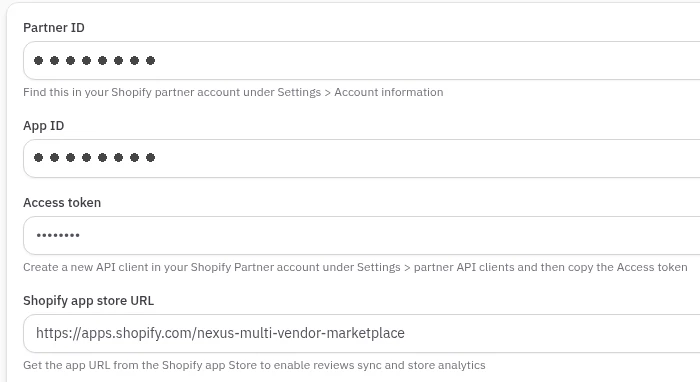
Example connection: connect with your Partner ID, App ID and a Partner API access token.
Where each value comes from, as the connect screen explains it:
- Partner ID: in your Shopify Partner account, under Settings > Account information.
- Access token: create a new API client in your Shopify Partner account, under Settings > Partner API clients. Then copy the access token.
- Shopify App Store URL: your app's listing URL. The screen says it turns on reviews sync and store analytics.
3. Move your affiliate program
Orbit by Marmeto is a separate product for Shopify app partner programs. It covers commission rules on subscription, one-time or usage charges. It also covers lead-based referrals by store URL, a partner sign-in, payables and receivables, and PayPal, RazorpayX or manual payouts.
You can import partners by CSV, then add their existing leads with the date each was referred. Orbit is free for Shopify app teams. See Orbit for the full feature set.
4. Redirect helpdesk, email, and rank tracking
Send support email, chat and Slack to Gorgias, Zendesk, Intercom or Help Scout. Bring your ticket history over through the API.
Rebuild your email segments and automations in Klaviyo, Customer.io or Loops. Start rank tracking again in App Store Pulse or Letsmetrix. Mantle's own FAQ also named Fusion Metrics. Your own rank history from before the switch may be hard to get back.
5. Handle billing on its own timeline
Mantle Billing ended on September 30, 2026. Mantle recommended Shopify App Pricing. At the time, App Pricing was only open to new apps, so Mantle pointed existing apps to the Billing API until Shopify's migration tooling arrived (Mantle's billing migration guide, archived).
On May 12, 2026, Shopify App Pricing replaced Managed Pricing as Shopify's default billing (Shopify changelog). It's now the default for new public apps. It's also Shopify's recommended path for existing apps whose pricing it supports (About billing for your app).
Did you use Mantle's Flex Billing? Check whether Shopify App Pricing supports your pricing model. If it doesn't, Shopify's docs point to Manual Pricing with the Billing API.
Shopify calls this the legacy method, but it still works. You don't have to move an existing Billing API setup to keep it running (About billing for your app).
What kept working, and what stopped
Your existing charges still live on Shopify. Mantle Billing created your subscriptions through Shopify's Billing API, so Shopify owns them. They kept billing after September 30. Merchants didn't have to approve anything again (Mantle's billing migration guide, archived).
What stopped is the work Mantle did around those charges. Check these first:
- Usage charges. Mantle turned your usage events into Shopify usage records (
appUsageRecordCreate). If your app didn't take that over, the base plan kept billing, but usage stopped being charged. - Flex Billing tier upgrades. A Flex plan is a $0 recurring line plus a capped usage line. Mantle decided when to move a merchant up a tier. Merchants stayed on their current tier, and the automatic upgrades stopped.
- New installs and plan changes. Your app has to create subscriptions itself with
appSubscriptionCreate. The merchant approves at the confirmation URL it returns. Or send merchants to Shopify App Pricing's hosted plan page. - Cancellations and billing webhooks. Handle
APP_SUBSCRIPTIONS_UPDATEon your side for Billing API subscriptions.
6. Reconcile before you fully cut over
Before you rely on your new dashboard alone, check its MRR, subscriber count and churn against your Mantle export.
Then check each merchant's live plan on Shopify. The Partner API's activeSubscription query returns the current plan, billing cycle and usage. Shopify's App Pricing guides say it covers both App Pricing and Billing API subscriptions (Shopify App Pricing).
Its API reference is narrower (Active subscription):
- It needs a Partner API client with the Manage apps permission.
- It works only for public apps.
- It returns
nullwhen the shop has no App Pricing contract.
If your app still bills only through the Billing API, test it on a development store first:
query ActiveSubscription($appId: ID!, $shopId: ID!) {
  activeSubscription(appId: $appId, shopId: $shopId) {
    billingPeriod
    cancelAtEndOfCycle
    trialEndsAt
    currentBillingCycle { startTime endTime }
    items { handle usage { quantity cost { amount currencyCode } } }
  }
}
If it returns null for a Billing API-only app, check the Admin API's currentAppInstallation before you treat that shop as unpaid. During a trial, trialEndsAt is set and currentBillingCycle is null.
When you match charges, use the Partner API transaction id, not chargeId. chargeId can be empty for charges before September 2020 (AppSubscriptionSale).
Shopify says transaction data is "for analytics purposes only" (Partner API). So your payouts are the final word on money. Last, remove any code or webhook subscription that still calls Mantle.
One more idea while you rebuild: add an in-app NPS (Net Promoter Score) survey. It can catch shifts in how users feel before they show up in revenue. Pulse, Marmeto's free in-app NPS survey tool, does this inside your app.
What You Had in Mantle, Where It Lives Now
Mantle put several products behind one login. No single tool replaces the whole bundle. But Marmeto has a product for each of the two parts most teams check daily: Elevate for analytics and Orbit for partner programs.
| What you had | Where it lives now |
|---|---|
| MRR / ARR / churn dashboard | Elevate by Marmeto (Shopify app analytics). Elevate builds your MRR, churn and merchant history from your Shopify Partner data when you connect, so there's no Mantle file to import. |
| Affiliate and partner program | Orbit by Marmeto (a separate product) |
| Billing | Shopify App Pricing, or Manual Pricing with the legacy Billing API for models App Pricing doesn't support |
| Helpdesk | Gorgias, Zendesk, Intercom, or Help Scout |
| Email and flows | Klaviyo, Customer.io, or Loops |
| SASI rank tracking | App Store Pulse or Letsmetrix |
If You Are Comparing Analytics Options First
A forced move is a good time to shop around. Here's how the main tools compare if you're replacing Mantle's revenue reports. For the full list, see Mantle alternatives for Shopify app analytics.
| Capability | Elevate | heyLunvo | Letsmetrix | Polar Analytics |
|---|---|---|---|---|
| Revenue analytics (MRR, ARR, churn) | Yes | Yes | Yes (history limited by plan) | Store revenue BI (business intelligence), not app MRR |
| Merchant history timeline | Yes | Yes | No | No (store BI) |
| Starting price | Free | Free during early access | Free plan; paid plans from $19/mo | From $750/mo (based on store GMV, or gross merchandise value) |
Sources, checked November 20, 2026: heyLunvo, Letsmetrix pricing, Polar Analytics on the Shopify App Store.
heyLunvo is built for Shopify app developers too. It has affiliates and a Mantle import in the same tool.
Letsmetrix is a free start for simple needs. It pairs revenue and churn from Shopify Partner with App Store rank tracking. Polar Analytics fits full-funnel store attribution across many sources. That's more than Shopify app analytics usually needs.
Billing Has Its Own Timeline
Billing had the later deadline, September 30, 2026. Mantle said it gave billing customers more time "to make the transition as smooth as possible." Billing is also where a mistake costs the most. If you get it wrong, your merchants may not be charged correctly.
| Detail | Where things stand |
|---|---|
| Recommended path | Shopify App Pricing, for apps listed on the Shopify App Store. It replaced Managed Pricing as Shopify's default billing in May 2026 (Shopify changelog). It's the default for new public apps and Shopify's recommended path for existing apps with supported pricing models (About billing for your app). |
| Migration tooling | Shopify's migration tooling is live. Shopify drafts App Pricing plans from your Billing API plans. You review them, test each one on a development store, then turn on App Pricing. New installs then use App Pricing. Existing subscriptions keep billing through the Billing API until you move them. Move them in the Partner Dashboard when a price matches one public plan. Use Shopify CLI (command line tool) for usage-based plans and anything else. A move takes effect at the start of the subscription's next billing cycle, not right away. Keep your Billing API code, including usage records, running until every move has taken effect. See Migrate to Shopify App Pricing. |
Edge cases and failure modes
Check these before you move a single subscription. Sources: migration guide, App Pricing limitations, About billing for your app and Mantle's billing guide, archived.
Moving a subscription
| Edge case | What happens | Source |
|---|---|---|
| Timing and notice | A move switches at the subscription's next 30-day billing cycle, or at renewal for annual plans. If the move changes billing terms, or you send an opt-out notice, the merchant gets at least 30 days' notice. If the next cycle is under 30 days away, the old terms then run one more period. That's a year for annual plans. | Migration guide |
| Active discount | A subscription with an active discount can't move until the discount ends. | Migration guide |
| Free trials | You confirm each plan's trial when you review the drafts. Shopify's guide doesn't say how a trial already in progress is treated when it moves. Test that on a development store first. | Migration guide |
| Usage and capped charges | Usage settings aren't copied. You set up meters and send usage with the App Events API. Usage subscriptions move only with Shopify CLI. A moved subscription loses its capped amount, because App Pricing has no capped amounts. | Migration guide; App Pricing limitations |
| Rollback | Before a move takes effect, you can cancel it with shopify app subscription-migrations unschedule. After it takes effect, you can't undo it. Once you turn on App Pricing, you can't create new recurring Billing API charges. | Migration guide; App Pricing limitations |
What App Pricing doesn't support
| Edge case | What happens | Source |
|---|---|---|
| Flex Billing | Flex was Mantle's own logic on a $0 plus capped usage line. Shopify has no equivalent. Rebuild the tier logic on the Billing API, or switch to regular tiers. | Mantle billing guide (archived) |
| One-time charges | App Pricing doesn't support them. Existing one-time purchases stay on the Billing API. For new sales, Shopify's migration guide lets you model a one-time charge as usage in a usage-only or combined plan. | About billing; migration guide |
| Prices in local currency | App Pricing plan prices are set in US dollars (USD) only. To set prices in a local currency, stay on Manual Pricing. | App Pricing limitations |
| Plan count | Up to eight public plans. To move subscriptions in the Partner Dashboard, keep exactly one public plan per recurring price, currency and interval. | Migration guide |
| Subscription webhooks | App Pricing doesn't send subscription webhooks. Apps already on it stopped getting them after April 28, 2026. Read plan_handle from the redirect. Query the Partner API's activeSubscription for cancellations and freezes. The move itself fires one APP_SUBSCRIPTIONS_UPDATE on the old Billing API subscription. After that, activeSubscription shows that subscription's ID in legacySubscriptionId. | App Pricing page; migration guide |
| When App Pricing is the wrong fit | If you rely on one-time charges, local-currency prices, more than eight public plans or Flex-style tiers, stay on the legacy Billing API for now. | About billing; App Pricing limitations |
How much work each path takes
| Billing path | What you own |
|---|---|
| Shopify App Pricing | No billing code. You still read the Partner API and set up meters for usage. |
| Legacy Billing API | Your own subscribe flow, usage records and webhooks. |
| Rebuilding Flex Billing | All of the above, plus metering and tier logic. This is the most work. |
Frequently Asked Questions
Has Mantle shut down?
Yes. Most Mantle services went off on August 14, 2026, for accounts without Mantle Billing. Mantle Billing accounts kept analytics, helpdesk and email until September 30, 2026. Then Mantle shut down fully.
I missed the August 14 deadline. Can I still export my data?
Probably not. Mantle said it kept data for 30 days after each end date, so the last window closed around October 30, 2026. If you can still get a file through Mantle's API or CSV reports, keep it to check your new tools against.
Which tool should replace Mantle's analytics?
Use a tool built for Shopify apps, such as Elevate by Marmeto. Elevate covers MRR, ARR and churn reporting for Shopify apps, and builds it from your Shopify Partner data. Polar Analytics fits teams that need broader marketing BI across many sources. For a full comparison, see the best Mantle alternatives for Shopify app analytics.
Will my historical MRR data survive the migration?
Only if you exported it before your account's cutoff. Mantle said its data would be destroyed after the wind-down. Elevate builds your MRR, churn and merchant history from your Shopify Partner data when you connect, so there's no Mantle file to import. Keep your Mantle export to check against.
What replaces Mantle's affiliate program?
Orbit by Marmeto, which is a separate product from Elevate. Orbit covers commission rules, lead-based referrals, payables, and PayPal, RazorpayX or manual payouts. Orbit is free for Shopify app teams.
Does Elevate replace Mantle Billing?
No. Billing moved to Shopify App Pricing or the legacy Shopify Billing API. Elevate covers analytics and customer data: merchant timelines, tags and customer exports. Elevate doesn't do billing, helpdesk or email. Partner programs move to Orbit.
Is Elevate free?
Yes. Elevate is free. See why your MRR moved in Elevate →. Sign up with Google or email. Then connect your Shopify Partner account.
Final Thoughts
Mantle was at the center of a lot of workflows. Losing it mid-year was a real disruption. But the shutdown was six separate moves, not one impossible one.
Helpdesk, email and rank tracking have mature replacements. For the two things most teams miss first, Elevate covers your revenue dashboard and Orbit covers your partner program.
Elevate is free. See why your MRR moved in Elevate →
Still have a Mantle export? Keep it to check your new numbers. Everything else can happen on your own schedule.